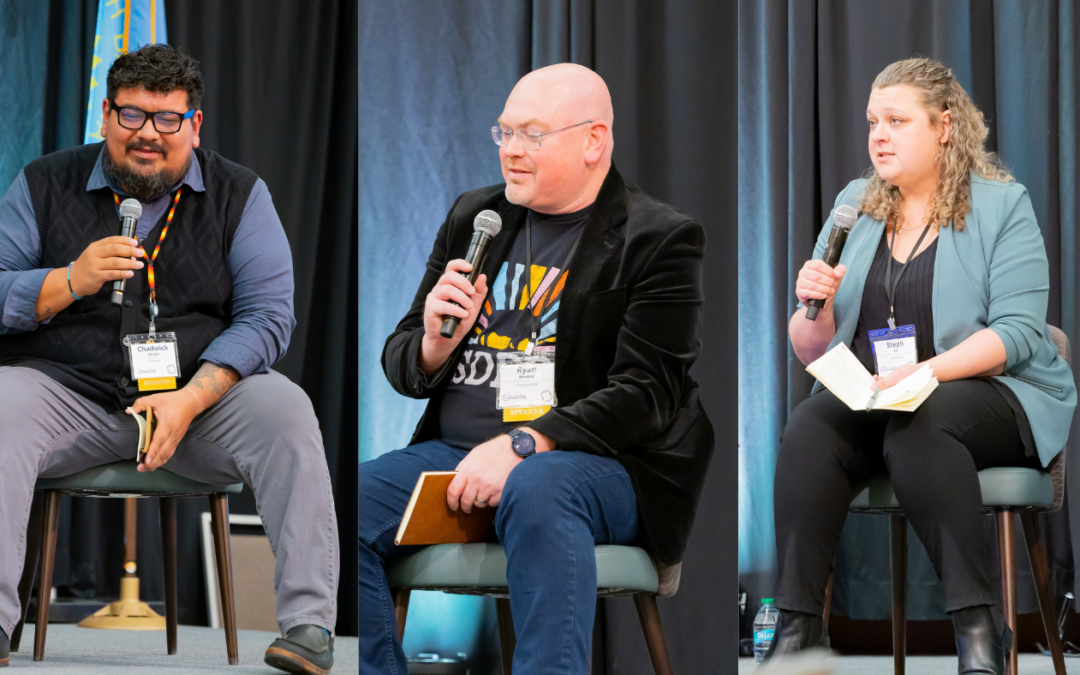
Executives from organizations across the Black Hills shared insights on overcoming adversity, boosting staff morale and workplace sustainability during an afternoon panel at the Nonprofit Leadership Summit hosted by JTVF in Rapid City, SD, in November 2025.
Building Teams
How do you build and maintain a resilient team in today’s environment?
Ryan Howlett, CEO for Friends of SDPB, a fundraising and advocacy group for SDPB
We’re really intentional about how we hire. We probably overthink it. We’re probably a little bit slower. We also have gone out of our way to recruit the candidates that we want. We have tried to pay at, or maybe slightly above, market [rate] on the nonprofit side.
I would rather have you with us for five, seven years and train you for a leadership opportunity—whether that’s at SDPB or Friends [of SDPB] or another nonprofit, rather than flip staff every 18 months. It’s made us so much more profitable. It’s made our culture so much healthier, because we have co-workers that we know how they’re going to react and we have a common bond with each other.
We made a choice probably about eight years ago to invest a little bit more in staff with the goal of higher retention and not flipping people, to try to keep the team together and it’s generally worked.
Steph Kor, Executive Director of Journey On, a supportive service for those dealing with homelessness and suicide, street outreach and case management
At Journey on we live by the motto, “You get to be human here.”
We talk a lot about what we need. There’s a lot of conversations about transparency and honesty. I came in almost two years ago, now, and we were we were not in a great financial position. We were not in a great staffing position. So, part of what we practiced was brutal honesty and transparency. I think staff had appreciation for that true transparency. They were just being told to do things and not understanding the why. In return, I’ve asked me what they need and why they need it. I think that’s opened a great conversation.
We have a ‘Zen Den’ in the basement of our facility. Sometimes our team with very intensely emotional, and sometimes physical, things. So, there’s a place where they can come just to decompress and spend time alone should they need to.
We also celebrate all the wins—that means sobriety dates, birthdays, things happening at home, when our kids do something amazing. We love sharing with each other all those wins.
You asked what motivates us. Sometimes we have to ask that to each other, “Why did you show up this morning? Why did you choose to work here?”
Also, we prioritize leadership through the team. I ask my team’s input on a lot of things that maybe not all leadership feels they should. I have found that if I let them help me create it, they’re more likely to support it. It’s helpful when everybody gets a chance to create that.
Chadwick Ratigan, Executive Director at OneHeart, a transitional housing campus in Rapid City
Understanding that staff, the people we work with, are not robots. Bringing empathy back into the workplace was a big thing when I was a Transformation Director, because the work that we do is hard. We see and we hear a lot of terrible things and that second-hand trauma is a real thing.
We have a wellness room on campus. It works well to give staff that space so that they can go through the motions and talk to somebody if they need to.
Also, getting out there and letting our staff know that we’re willing to do the jobs that they are also, right? There was one day when our buildings and grounds crew were really short staffed. I think all of us were out mowing the grass, weeding the yards, painting rooms.
Just showing staff that we’re willing to do the jobs that they are doing so we also understand where they’re coming from when things do happen.
Tackling Challenges
What’s a major challenge you faced recently and how did your team navigate it?
Ryan Howlett, CEO for Friends of SDPB
We lost 20% of our budget, essentially, overnight. One of the keys to success was we gave ourselves three months to plan. Ideally, [Congress] would have cut off that funding after two years and not it clawed back [via congressional recission at the request of the Trump Administration], so we would have had time to plan an off ramp. But that didn’t happen.
For the most part, after the first four days—because that vote was on a Thursday, by the time we came back in on Monday everybody was committed to staying positive.
Even the stuff in the South Dakota legislature [during the 2025 legislative session when Gov. Kristi Noem proposed cutting SDPB’s budget by $3.6 million], everybody stayed positive. We made a choice to keep our messaging positive, to reach out to your legislators in a positive manner. We never slammed our former governor or the administration for trying to defund in a way that would have forced us to close up shop in like 18 months.
We just stayed focused on what we had to do. Fear is a powerful motivator. One of my co-workers, Kate Ryan, our membership director, said, “Ryan, if we don’t kick butt this next year, we’re going to go away.”
I wrote that on my white board and we just said, “Full gas.” More than anything it was absolute attitude to stay positive. We made sure that when people asked us how to lobby and how to reach their legislators, we said, “Put it in your own words,” which I think was absolutely key because we just heard from so many legislators that they had thousands upon thousands of emails and calls and they were all personal and they weren’t form letters.
We stayed positive and told our story in an authentic way and we worked really, really hard.
Steph Kor, Executive Director of Journey On
One of the challenges Journey On has really faced is change saturation.
In the past few years, there’s been a lot of leadership changes—a lot of in and out, a lot of changes in the mission during COVID. So, we focused on getting back to the basics. Let’s bring it back. Let’s talk about what we’re really, really good at, what we want to focus on and how we build on the strengths that are already there.
The success that we’ve had now is literally just taking a breath, forgetting everything that we’ve built up in this messy cog, and then going back to the basics and building on what we could use and then what to get rid of.
Also, one of the best ways for me personally to face challenges is I’ve leaned on a lot of people in this room.
This leadership role is new to me, and I see a lot of faces throughout here that I’ve called, I’ve reached out to. I’ve picked their brain and everybody has been very gracious to let me do that. I’m not afraid to ask questions. I think that’s one of the ways that we survive those challenges is we lean on the people who have already been in a similar situation.
Ask a zillion questions and ask forgiveness and grace. I’ve been afforded that many, many times.
Chadwick Ratigan, Executive Director at OneHeart
Probably the largest challenge that we face at OneHeart is staffing. I know everybody can relate to staffing issues, but the really cool thing that we have is once we have staff shortages, all our core staff are more than willing to put in the extra work. They’re willing to take on more duties because they know at the end of the day we’ll be able to find other people who love what we do, who are mission-oriented, and want to be on the campus.
So it makes the hard times—anytime really when things get difficult—a lot easier because you have those dependable staff who are there and want to see everybody succeed.
Taking Bold Steps
What guidance would you give to leaders who want to take bold steps in their community work?
Ryan Howlett, CEO for Friends of SDPB
Take time to really think about what your mission is and stay true to that and stay focused.
If you’re trying to house people or if you’re trying to educate people or whatever that may be, be relentless about your mission and stay on task.
There’s a million things we could all do, but you’re going to water it down if you don’t do that.
Steph Kor, Executive Director of Journey On
Mine is just consistently showing up. Just keep showing up and always aim to leave everyone better than you find them.
Chadwick Ratigan, Executive Director at OneHeart
One of the biggest things that I recommend for advice is if you’re dreaming big—you’re trying to be innovative—you have to be ready to answer “why.” And be ready to ask “why.” Because, when you’re trying to be innovative and you’re dreaming big, some communities aren’t always ready for that, right?
“Not in my backyard.”
I think Charity [Doyle, President of OneHeart] heard that also when she was developing OneHeart. People kept asking, “Why? Why do you want to do this here?”
And then you or your responses explain it and say, “Why don’t you want it here?”
With our case managers, we always ask them to ask our guests when they’re struggling, “why?” Eventually, if you ask why enough you get down to the root cause of the issue.
Just be ready to answer why and ask why a whole bunch of times.
Good Advice
What’s one idea, mindset, or practice you hope attendees take away from today to apply in their own work?
Ryan Howlett, CEO for Friends of SDPB
Find, whether it’s a half an hour or 2 hours every week, where you can take time for yourself to think about the things that you need to do and really prioritize your list.
Take that time to problem solve and let your brain not be distracted by email, by phone calls. Find that private moment where you have the ability to really think through a problem to solve it for your organization.
Steph Kor, Executive Director of Journey On
Show up everywhere with an open mind and realize that you can only control what you can control. Sometimes it’s not worth stressing about the things that are above our pay grade or out of our control, so we can focus on the things we can control.
Chadwick Ratigan, Executive Director at OneHeart
Have an open mind. I know it’s difficult in this field. It’s difficult in the city and across the state when it comes to non-profit work. But always remind yourself that no amount of regret is going to change tomorrow. No amount of anxiety is going to change the future.
Living in the present is important. Yes, we have to plan for budgets. Yes, we have to look at the past and realize that this is how we build off of our mistakes. But, keep an open mind to the what is, and that’s right now.
It’s important that we collaborate as agencies and that’s the whole point of this to try and bring people together. For us, poverty doesn’t pick and choose. It can happen to anybody.